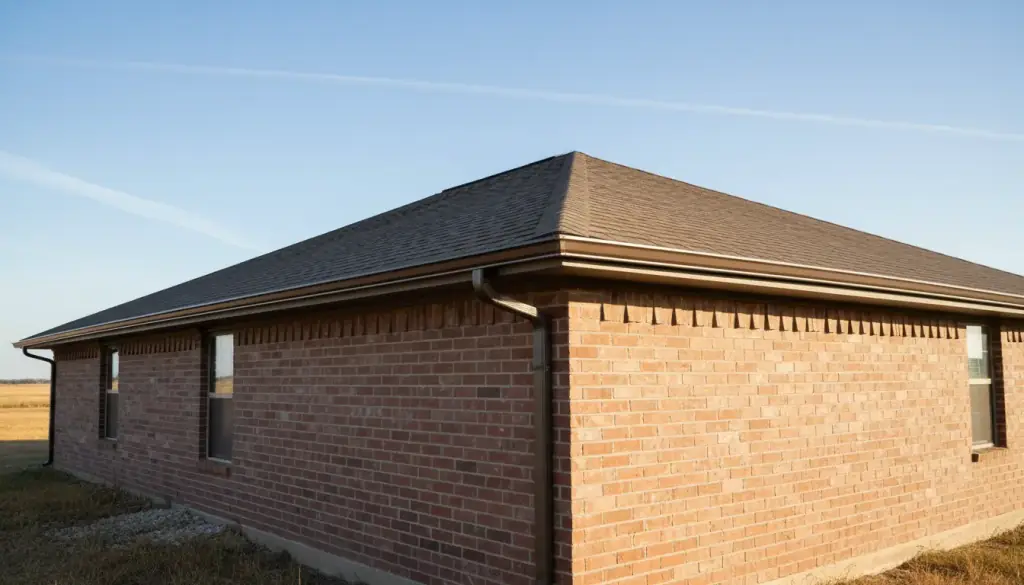
Where the water goes when a gutter fails
A gutter has one job, which is to take what the roof sheds and hand it to a downspout. When a run sags, clogs or pulls away from the fascia, the rain does not stop arriving. It goes somewhere else, and on a house in Paris, TX it usually goes to one of four places.
First it spills over the edge, most often at a valley where two roof planes meet and the flow is heaviest. Some of that water runs back behind the gutter and soaks the fascia board and the rafter tails, and wood that stays damp for long enough goes soft. The water that does clear the edge lands right against the foundation, where it splashes soil up onto the siding and soaks in beside the slab. Over a few seasons it cuts a trench along the drip line and carries the mulch out of the bed with it.
None of this announces itself with a leak in the living room. It shows up as paint peeling off the fascia, a brown stain under the eave, a gutter that leans away from the wall, or a muddy channel next to the house after a hard rain. Those are the signs worth a phone call. Caught early, a gutter problem stays a gutter job instead of turning into a fascia, siding and landscaping job.
What Reliant hangs along the eave
Reliant handles gutter installations, gutter repairs and full system replacements. The gutters are seamless aluminum gutters, formed as one continuous run instead of short sections joined end to end, so a long straight stretch has no mid-span joints waiting to open up and weep.
The trough is held to the fascia with hidden hangers. They sit inside the gutter rather than showing as spikes or ferrules along its face, which keeps the line clean when you look at the house from the street. The downspouts are aluminum as well, and they come in a variety of colors, so the system can blend into the trim or stand out from it, whichever you prefer.
Reliant is a roofing company first, so the gutter is fitted with the roof edge in mind rather than as an afterthought. If a reroof is already on your list, ask about both jobs in the same conversation. The supervisor who is on site makes sure the work is done to your satisfaction, and the same crew habit applies here as on a roof: the job is explained before it starts, and the yard is cleared when the trucks leave.
Ten-foot gutter guards and the checks worth making each fall
Reliant also installs 10-ft aluminum gutter guards. A guard is meant to keep leaves and debris out of the trough while still letting water in. Whether a particular house needs one depends mostly on the trees overhead, and the easiest way to decide is to look at how much debris your gutters collect between cleanings.
Guard or no guard, a walk around the house in the fall is worth ten minutes. Once the leaves are down, look along each run for sags, gaps at the joints and stains on the fascia behind it. Run a garden hose into the high end of a gutter and watch the water reach the downspout. If it pools, backs up or drips from a seam, you have found your problem before the next storm did. Then check where each downspout ends: the water should leave the pipe and travel away from the foundation, not settle beside it.
After a storm, repeat the quick version from the ground. Straight-line wind and hail can bend hangers, dent a run or knock a downspout loose, and debris from nearby trees ends up in the trough. Stay off a wet ladder and do not climb onto a roof to look. If something seems off, call Reliant at (903) 784-1111 and ask for a free estimate, and someone will come out and look at it properly.